
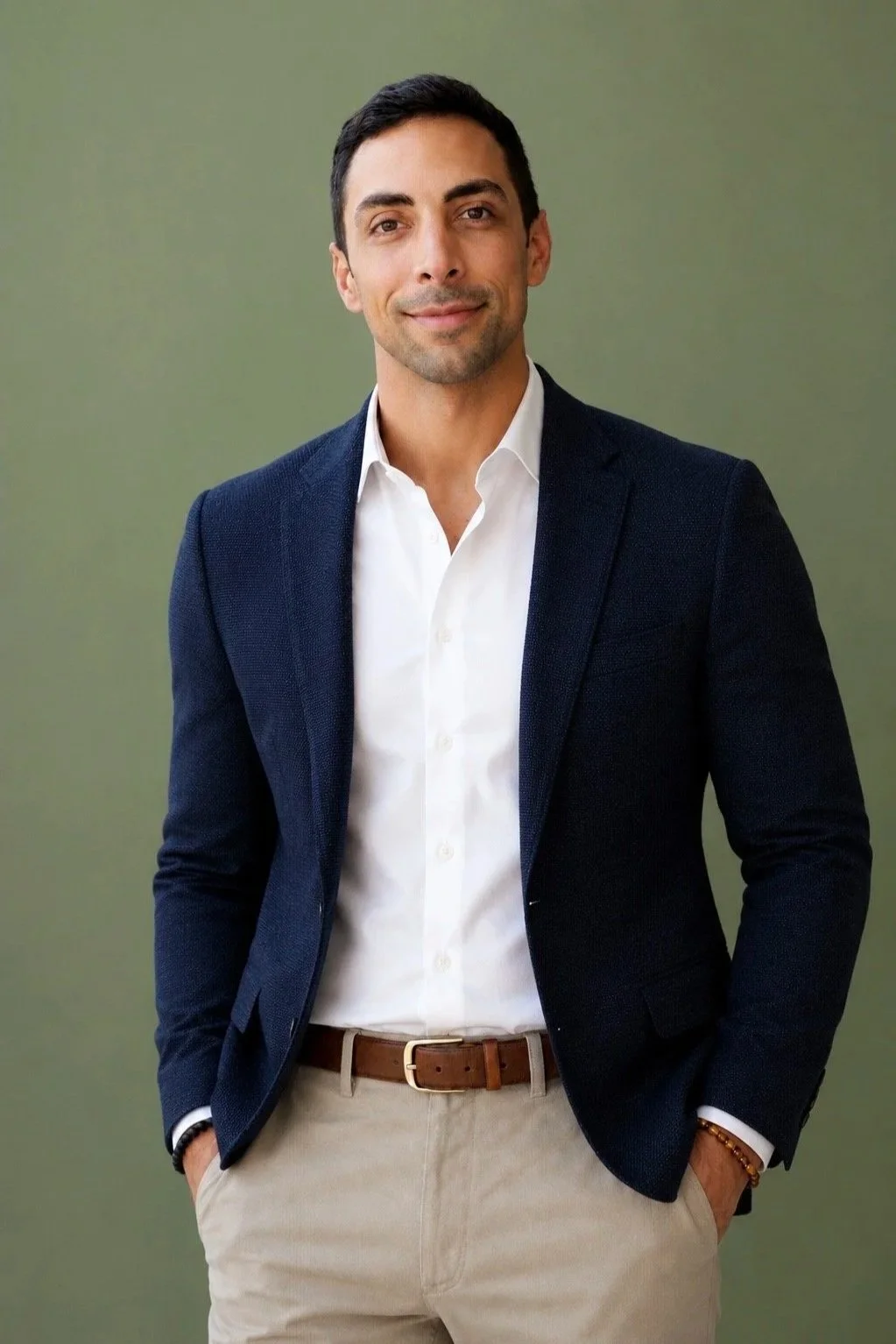
We cannot build the life we dream of while continually overriding what is happening underneath.
I was born into war. At eleven years old, I left my birth country, my friends, and much of my family behind and immigrated to Canada with very little English. I felt lonely and isolated. Anxious and scared.
My survival instincts taught me how to keep moving forward. That became one of my greatest strengths. And eventually, one of my greatest blind spots.
I built a life that looked successful from the outside. I earned a degree in architecture from Toronto Metropolitan University and later an Executive MBA from the Rotman School of Management at the University of Toronto. I spent nearly two decades in corporate real estate development, overseeing complex construction projects and eventually becoming a Vice President before turning forty.
I travelled the world. Competed in sports. Played music. Led teams. Built businesses. Took risks. But underneath all of it, something hadn't changed.
A few years ago, I found myself face-to-face with the one thing I had spent years trying to outrun.
I was still anxious. Still searching. Still unsure of my purpose and why I was getting up every morning.
Was I building this life for me, or to make other people proud of me?
And underneath all of that was an even harder question:
Was I truly proud of myself?
In many ways, beneath all the accomplishments, I could still feel that eleven-year-old boy who had arrived in a new country scared, uncertain, and trying to find his place.
For the first time, moving forward wasn't enough.
And that was terrifying. I felt lost. In my mid-thirties, I hit rock bottom.
There was only one place left to go. The scariest place of them all.
Inward.
That journey is a long story of its own for another time. But it eventually brought me to breathwork, Zen, and somatic practices. And slowly, I began learning something completely different from everything achievement had taught me.
Instead of escaping discomfort, I learned to sit with it.
Instead of immediately trying to solve what I was feeling, I learned to breathe through it.
Instead of treating anxiety and fear as things that needed to disappear, I began building the capacity to stay present when they arrived.
And through repetition, I began rebuilding something I hadn't realized I was missing:
Trust in myself.
That changed the question I was asking. I stopped asking how to eliminate fear, pressure, and uncertainty, and started asking:
How do I become someone I can trust when they arrive?
That question eventually became the foundation of my SOLHAM Method.
Because what I learned through my own experience is something I now see repeatedly in my clients:
You can perform at an incredibly high level while your emotional state and nervous system are working against you.
You can be very accomplished and still very anxious.
Very successful and still not content. Still searching for clarity.
Strong and still exhausted from constantly having to be strong.
Achievement can change your circumstances. But it cannot, on its own, create the relationship you have with yourself.
That relationship has to be built. And it always begins with trust.
Trust is step one. It is the foundation.
About Mark
Over the years my work has been shaped by nervous system science, somatic practice, breathwork, mindfulness, movement, Zen philosophy, and a great deal of personal trial. Eventually I noticed the practices that were creating the greatest change in my own life kept returning to four foundations: Trust, Regulation, Presence, and Beliefs. Those became the four pillars of the SOLHAM Method. When practiced consistently and with conviction, they move us toward four outcomes: Purpose, Peace, Place, and Power.
I did not build SOLHAM because I found a life without pressure or uncertainty. I built it because it was necessary. This past couple of years I’ve had to dig very deep. Losing my life partner of seven years and a significant professional transition gave me the opportunity to reconsider what I wanted the next chapter of my life to stand for. Instead of immediately rebuilding what was familiar, I chose to create space and put meaningful time behind work I truly believe in.
Nearly two decades in real estate development, construction and leadership shaped how I think, how I make decisions, how I lead people, and how I show up when there is pressure in the room. Those experiences remain an important part of who I am. What changed was my willingness to trust myself before knowing exactly what came next. That is also what I ask of my clients.
Why I Do This Work
Today I facilitate breathwork and nervous system experiences, work privately with clients, lead groups, and develop wellness experiences through SOLHAM and my work as a partner at NRG Haus Wellness Social Club.
Breath is where all of this began for me, long before I understood why. It is the first thing I teach now. People often tell me I seem calm and grounded. I take that as one of the greatest compliments I can receive, because I know those qualities were built through consistent inner work.
SOLHAM exists for people who sense there is higher level of themselves available. Sometimes that means breathing through anxiety or stress. Sometimes it means navigating change, finding clarity, performing under pressure, or reconnecting with a sense of direction. The circumstances differ. But the foundation is always the same.
You do not need a life without uncertainty and pressure. You need a foundation you can trust when uncertainty and pressure arrive.
That is what I help you build.